Rutgers Ecology & Evolution Graduate Student Association
  • Blog
  • About
    • Members
    • Ecology & Evolution Program
    • History
    • Constitution
    • Minutes
  • Seminars
    • Student Seminars
    • Department Seminars
    • Eminent Ecologist
  • Instagram Feed
  • Multimedia
    • Videos
  • Resources
    • EcoGSA
    • Program
  • Contact
  • Recent Publications

Congratulations to Rita Grunberg on two new publications!

1/16/2019

 
Picture
Here are some of the highlights in these lovely papers:

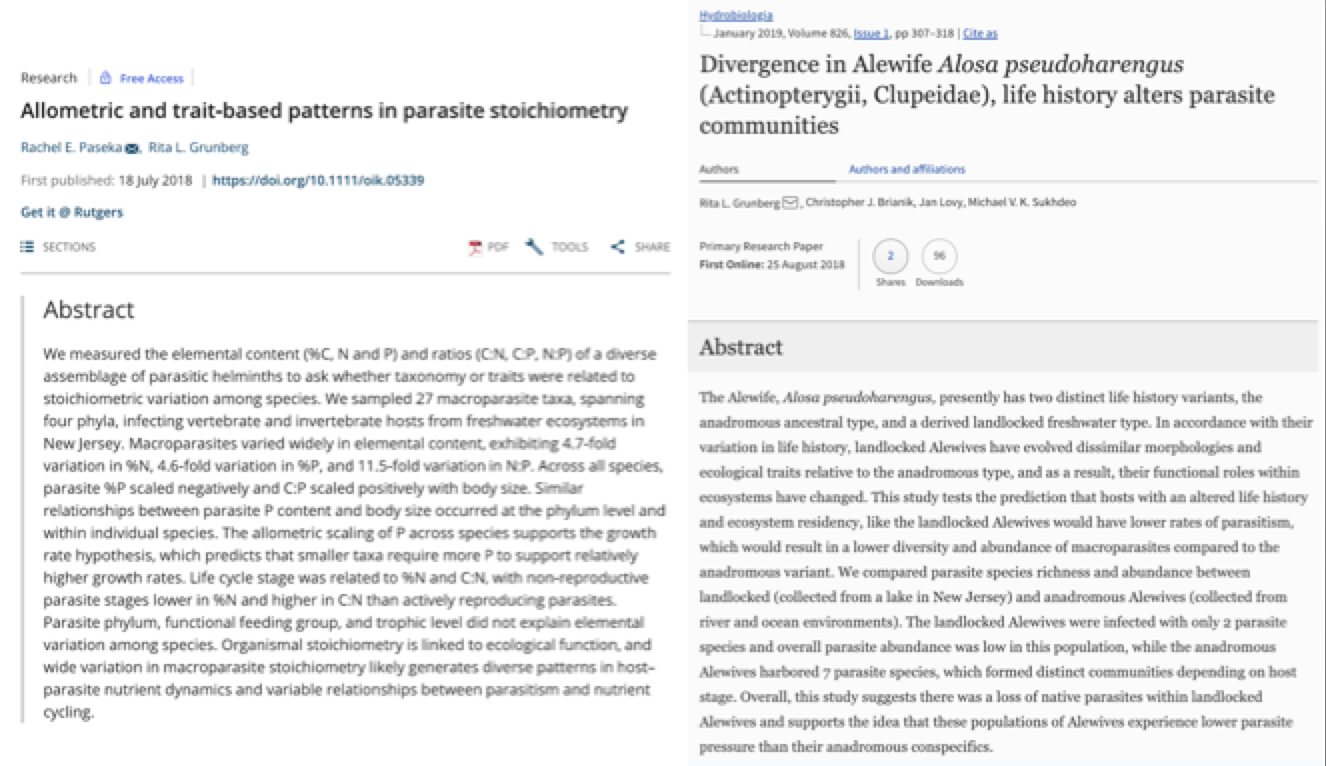
Divergence in Alewife Alosa pseudoharengus (Actinopterygii, Clupeidae), life history alters parasite communities:
  • Compared the parasite communities in two life history variant of Alewives, the ancestral anadromous type and the new landlocked resident.
  • Anadromous Alewives harbored a diverse parasite community that was structured based on host ontogenetic stage. 
  • The landlocked, freshwater resident was infected with a depauperate parasite community and overall infrequently infected. 
  • The data suggests the landlocked fish have lost their parasites when they colonized lake habitats, and highlights the role of parasitism in eco-evo feedbacks in aquatic systems. 
Allometric and trait-based patterns in parasite stoichiometry (coauthored with formerE&E graduate student Rachel Paseka):
  • Using the framework of ecological stoichiometry (ES) we documented wide variation in organismal stoichiometry (C,N,P) across parasitic taxa and linked this variation to certain traits.
  • Phosphorus content was strongly linked to parasite body size, and this agreed with the growth rate hypothesis in ES. 
  • Parasite life cycle stage did explain some variation in parasite stoichiometry. While, phylogeny, feeding strategy and trophic level did not. 
  • Finally, we advocate for the use of ES to link parasites to ecosystem function. 

Congrats to Michael Acquafredda on the new publication!

1/3/2019

 
Picture
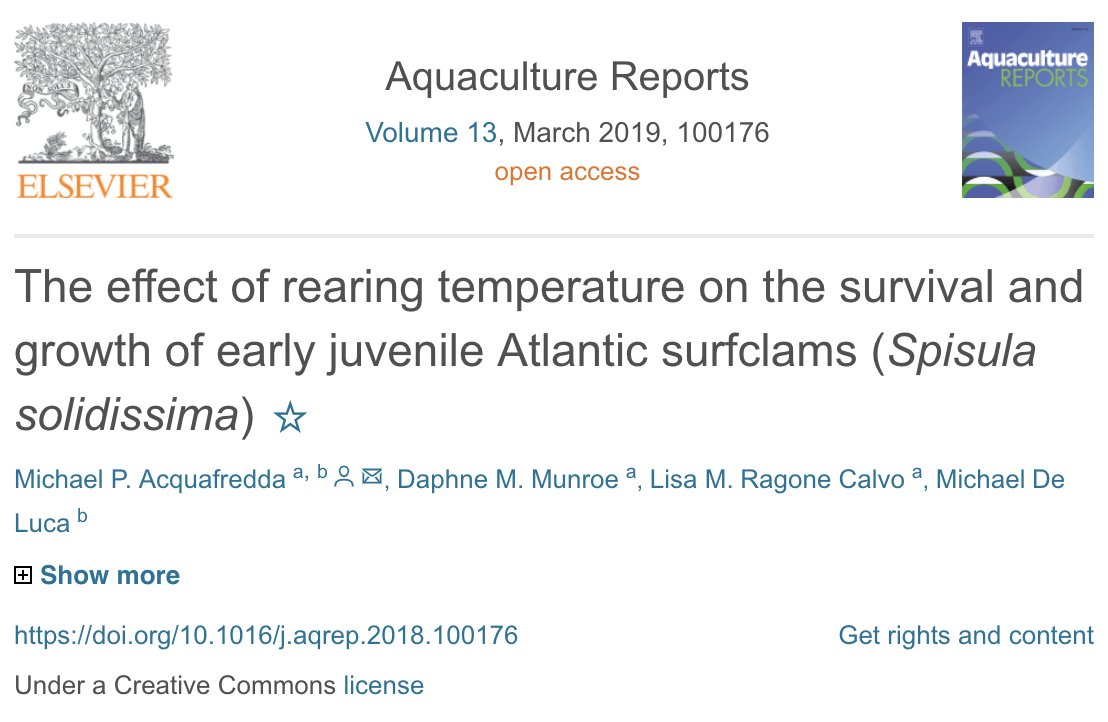
The article is open-access which mean that it’s free and available to anyone interested in learning best practices for culturing this native and delicious bivalve species!

Some highlights from the paper include:
"1. Juvenile surfclam survival and growth were optimized at 20C.
2. Colder water increases survival but slows growth; warmer water causes mortality.
3. Variation across clam cohorts suggests parentage influences temperature tolerance.
4. Commercial surfclam seed production is readable in the Northeast US."

The full paper can be found at: https://www.sciencedirect.com/science/article/pii/S2352513418301078
    Picture

    We seek to further the social, cultural, academic and research interests of the students in the graduate program in Ecology and Evolution and act as a link between the graduate students and the faculty.

    Archives

    May 2024
    November 2023
    October 2023
    June 2023
    May 2023
    March 2023
    November 2022
    September 2022
    August 2022
    April 2022
    February 2022
    October 2021
    May 2021
    March 2021
    November 2020
    October 2020
    September 2020
    August 2020
    June 2020
    March 2020
    December 2019
    October 2019
    September 2019
    July 2019
    April 2019
    March 2019
    February 2019
    January 2019
    April 2018
    March 2018
    February 2018
    January 2018
    December 2017
    November 2017
    October 2017
    August 2017
    May 2017
    March 2017
    February 2017
    January 2017
    December 2016
    August 2016
    June 2016

    Categories

    All

    RSS Feed

Powered by Create your own unique website with customizable templates.
  • Blog
  • About
    • Members
    • Ecology & Evolution Program
    • History
    • Constitution
    • Minutes
  • Seminars
    • Student Seminars
    • Department Seminars
    • Eminent Ecologist
  • Instagram Feed
  • Multimedia
    • Videos
  • Resources
    • EcoGSA
    • Program
  • Contact
  • Recent Publications